2 conspiracy for the price of 1

2 conspiracy for the price of 1
By Administrator
#qanon, #tartaria, #correlation, #skeleton, #pattern, #recognition, #anomaly, #fakehistory
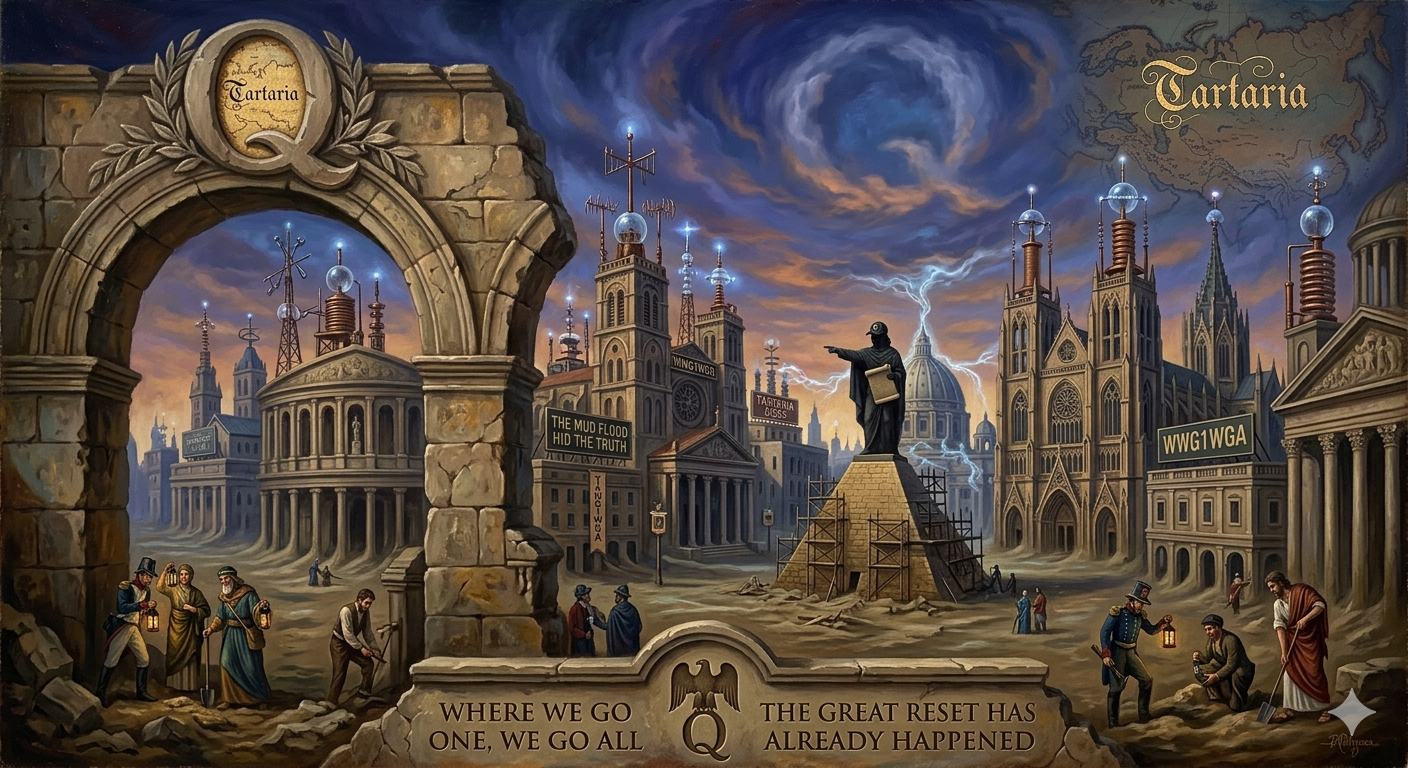
The "Tartaria" conspiracy is often nicknamed the "QAnon of architecture" because of how it recruits followers online and its radical distrust of official history. While they focus on different topics, these two theories share deep structural and communal links.
Points of Convergence
"Cafeteria" Narrative Structure: Like QAnon, the Tartaria theory has no single author or fixed doctrine. Followers can "pick and choose" the elements they like (giants, free energy, mud floods) and ignore others, creating an interactive, evolving alternative reality.
Distrust of Institutions: Both movements are built on the idea that a malevolent elite (or a "Deep State") has deliberately hidden the truth from the public to control them. In Tartaria's case, this elite allegedly erased an advanced global civilization to impose a "degenerate" modern society.
Community Overlap:
On platforms like Telegram, Reddit, or TikTok, QAnon and Tartaria threads often intertwine. Many "truth seekers" who started with QAnon turn to Tartaria to find evidence of a glorious, spiritual past that was stolen from them.
What is the Tartaria Theory?
This theory claims that a technologically advanced global empire called Tartary (or Grand Tartaria) existed until the 19th century. Its main pillars include:
The Mud Flood:
A global catastrophe that supposedly buried the first floors of Tartarian buildings, explaining why the basement windows of many old buildings appear halfway underground.
Free Energy:
The domes, spires, and antennas of classical buildings (like the U.S. Capitol or cathedrals) are claimed to be wireless atmospheric energy harvesters rather than decorative features.
Rewriting History:
World’s Fairs (like San Francisco 1915) are seen as excuses to demolish the last Tartarian cities by pretending they were temporary structures.
Historical Origins:
Historically, "Tartary" was not a country but a general geographic term used by European cartographers to describe Central Asia and Siberia—similar to how the term "The Orient" was once used. The modern theory emerged in the early 2000s, heavily influenced by Anatoly Fomenko’s "New Chronology," a Russian theory claiming that ancient history is a massive forgery.
Evaluation of Available Information:
Common Ground:
Both QAnon and Tartaria theories thrive on a shared foundation of distrust in established institutions, historical narratives, and mainstream media. They attract individuals with a penchant for alternative explanations and a desire to uncover hidden truths.
Overlapping Themes:
Both theories often intertwine with themes of hidden elites, secret societies, and a global cabal seeking to control humanity. They posit that powerful forces are manipulating world events and suppressing knowledge from the masses.
Target Audience:
Both QAnon and Tartaria conspiracies resonate with individuals who feel marginalized, disenfranchised, or disillusioned by the modern world. They offer a sense of belonging and empowerment by claiming to possess esoteric knowledge that challenges the status quo.
Realistic and Well-Structured Answer:
The link between QAnon and Tartaria conspiracies lies in their shared appeal to marginalized individuals seeking alternative explanations for complex world events. These theories often blend and reinforce each other, creating a potent narrative of hidden elites, suppressed histories, and a global battle for truth.
QAnon as a Gateway:
QAnon, with its promise of exposing a vast pedophile ring and the imminent downfall of the "Deep State," serves as a gateway for individuals to explore other alternative theories, including Tartaria. The QAnon narrative primes followers to question official accounts and embrace fringe ideas.
Tartaria as Hidden History:
Tartaria, with its claim that a technologically advanced civilization was deliberately erased from history, provides a plausible explanation for the perceived anomalies and inconsistencies in mainstream narratives. It suggests that the "Deep State" has rewritten the past to conceal its own nefarious activities.
Reinforcing Narratives:
The two theories become intertwined as QAnon followers adopt Tartaria's claims about a hidden history and a global cabal controlling the world, while Tartaria adherents embrace QAnon's promise of a coming reckoning and the exposure of corrupt elites.